
☁️ Welcome to Cloud City: Your Journey into the Digital Skies Begins Here!
Imagine waking up one morning and discovering that your smartphone magically knows your favorite music, your laptop seamlessly syncs with your tablet, and your photos appear everywhere you need them without you lifting a finger. Welcome to the cloud revolution—a world where technology feels less like work and more like magic!
As we embark on this exciting series about cloud technologies, we’re ditching the boring textbooks and technical jargon. Instead, think of this as your personal tour guide through Cloud City—a vibrant digital metropolis where your data lives, your applications play, and innovation never sleeps. Whether you’re a complete newbie or someone curious but never quite got it, this series will transform you from a cloud-curious wanderer into a confident digital citizen.
🌟 Why Cloud Computing is Like Having a Digital Superpower
Let’s start with a story. Remember when you had to carry a heavy backpack full of books, notebooks, and supplies everywhere you went? Now imagine if you could just wave your hand and instantly access any book, any note, or any tool you need—from anywhere in the world. That’s essentially what cloud computing does for your digital life.
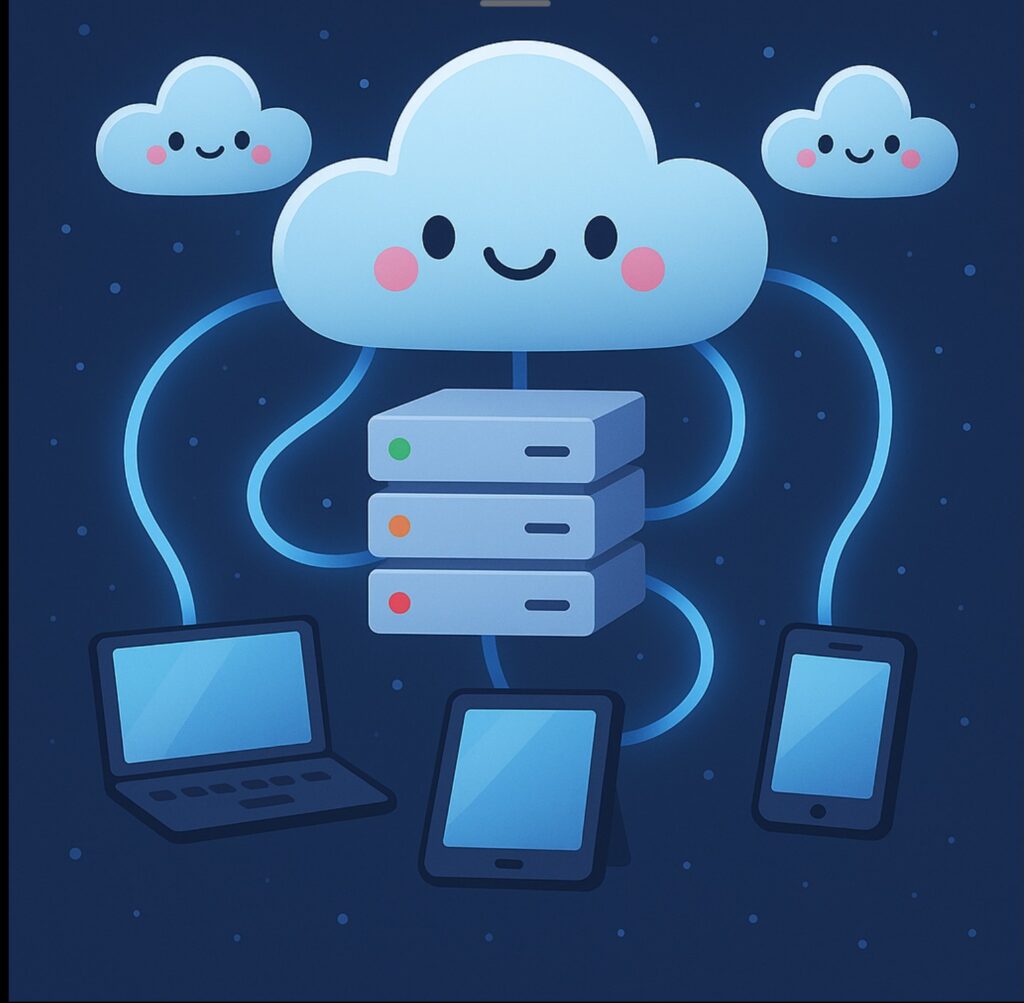
Cloud computing is the delivery of computing services—including servers, storage, databases, networking, software, analytics, and intelligence—over the internet, colloquially known as “the cloud”. But let’s make this more relatable with some fun analogies that actually make sense.
The Netflix Analogy: Entertainment On-Demand
Think about how you watch Netflix. You don’t own a massive warehouse of movies, nor do you need a Hollywood-grade projector in your living room. Instead, you simply open the app, choose what you want to watch, and voilà—entertainment appears on your screen. The cloud works the same way with computing power and storage.
The Spotify Metaphor: Your Digital Music Library
Remember when people collected thousands of CDs? Now you carry millions of songs in your pocket through Spotify. You don’t store the music locally—it streams from powerful servers when you need it. Cloud computing lets businesses do the same thing with their software and data.
🚀 The Cloud Evolution: From Mainframes to AI Magic
Cloud computing didn’t just appear overnight like a digital thunderstorm. It has a fascinating history that’s more like a tech adventure story spanning decades.
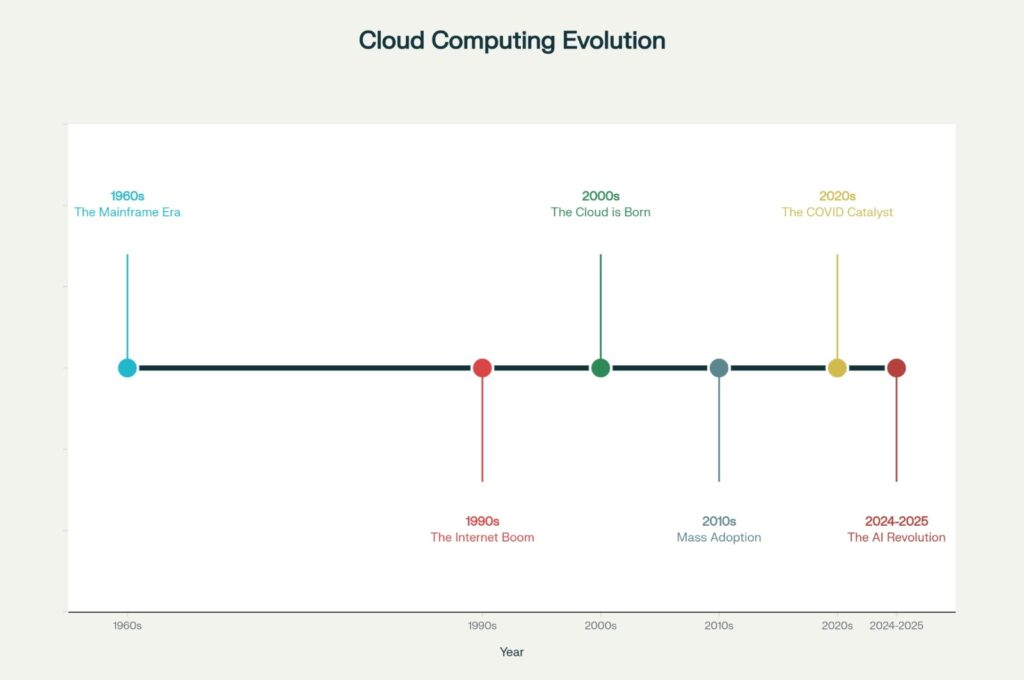
- The 1960s – The Mainframe Era: Back when computers were room-sized behemoths, the concept of “time-sharing” allowed multiple users to access a single powerful computer remotely. It was like having a digital library where people took turns using the same incredibly expensive book.
- The 1990s – The Internet Boom: The internet explosion created the foundation for cloud computing by providing the high-speed networks necessary for remote computing.
- The 2000s – The Cloud is Born: Companies like Salesforce pioneered Software-as-a-Service (SaaS), while Amazon launched AWS in 2002, marking the true beginning of modern cloud computing.
- The 2010s – Mass Adoption: Microsoft Azure (2010), Google Cloud Platform, and countless other services made cloud computing mainstream, transforming how businesses operate.
- The 2020s – The COVID Catalyst: The pandemic accelerated cloud adoption by 5-10 years as remote work became the norm.
- 2024-2025 – The AI Revolution: Today’s cloud is powered by artificial intelligence, edge computing, and serverless technologies that make computing more intelligent and accessible than ever.
🏗️ Cloud Architecture: Understanding the Digital City
To understand how the cloud works, let’s use the Hotel vs. House analogy that IT professionals love:
Your Personal Computer = Owning a House
- You own it, maintain it, and are responsible for everything
- If something breaks, you fix it yourself or hire someone
- You have complete control but also complete responsibility
- Space is limited by what you initially built
Cloud Computing = Staying in a Hotel
- You can choose your room type, location, and duration
- Hotel staff maintains everything—you just enjoy the service
- Easily upgrade, downgrade, or change locations
- You only pay for what you use, when you use it
The Three-Layer Cloud Architecture
Modern cloud architecture has three main layers, like a fancy apartment building:
- Front-End (Your Interface): This is like the hotel lobby—it’s what you see and interact with. Whether you’re using a web browser, mobile app, or desktop software, this is your gateway to the cloud.
- Back-End (The Engine Room): These are the powerful servers, storage systems, and databases that do all the heavy lifting—like the hotel’s kitchen, housekeeping, and maintenance departments working behind the scenes.
- The Network (The Digital Highway): This includes the internet, internal networks, and all the connections that make everything work together seamlessly.
🎯 The Holy Trinity of Cloud Services: IaaS, PaaS, and SaaS
Let’s break down the three main cloud service models using a restaurant analogy that’ll make you hungry for knowledge:
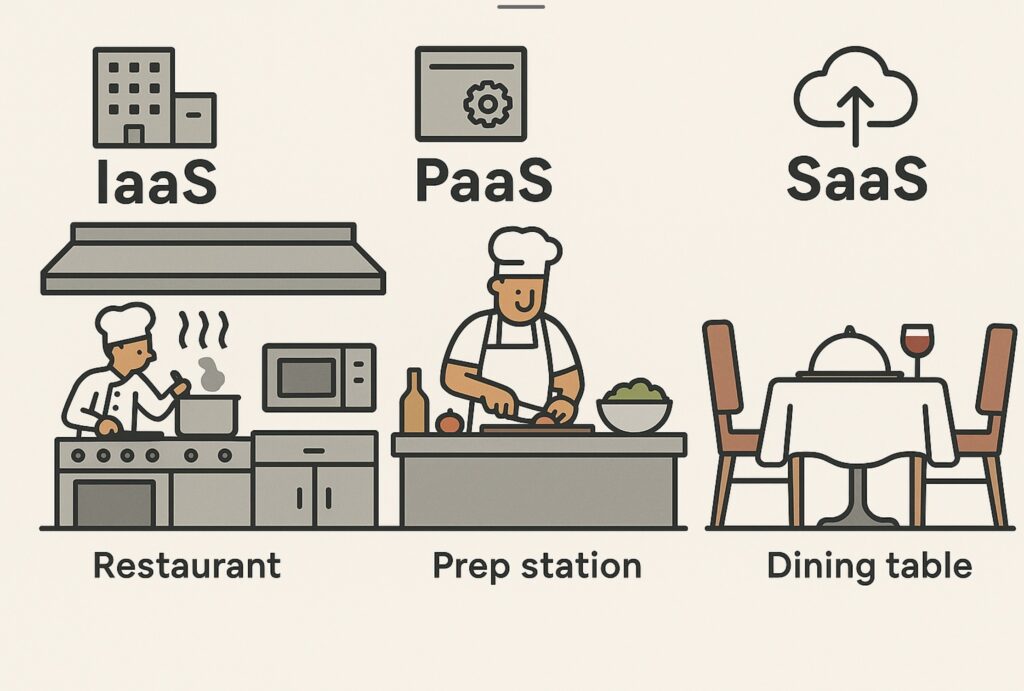
Infrastructure as a Service (IaaS) = The Raw Kitchen
You get the basic cooking equipment, stove, and ingredients, but you’re responsible for preparing the entire meal. Examples: Amazon EC2, Google Compute Engine.
Platform as a Service (PaaS) = The Prep Kitchen
The kitchen is set up, ingredients are prepped, and you just need to focus on cooking your specific dish. Examples: Google App Engine, Microsoft Azure App Service.
Software as a Service (SaaS) = The Full-Service Restaurant
You just sit down, order from the menu, and enjoy the meal. Someone else handles everything. Examples: Netflix, Spotify, Google Workspace, Microsoft 365.
🌈 Cloud Deployment Models: Choosing Your Digital Neighborhood
Not all clouds are created equal! There are different types based on your privacy needs and control preferences:
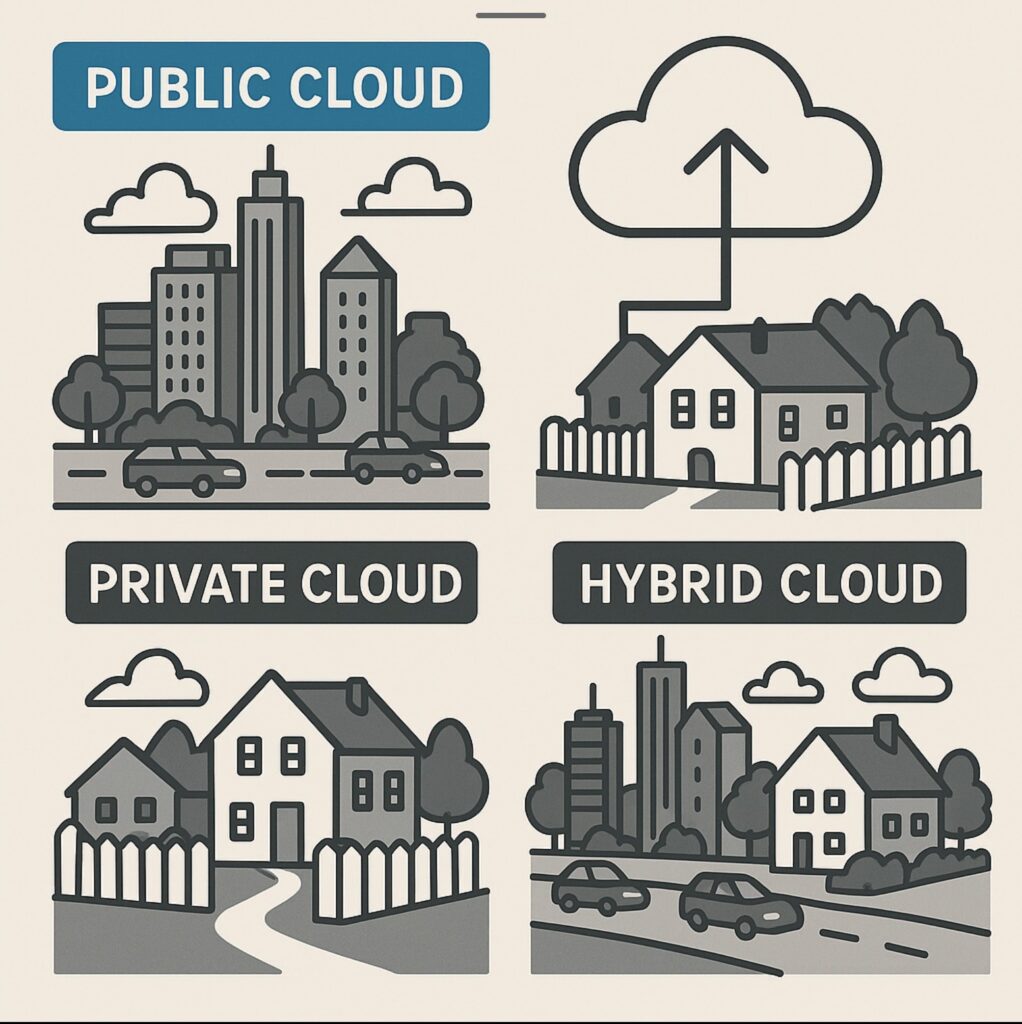
Public Cloud: The Bustling Downtown
- Open to everyone, like a busy shopping mall
- Most cost-effective and scalable
- Examples: AWS, Microsoft Azure, Google Cloud
Private Cloud: The Gated Community
- Exclusive to your organization
- Maximum security and control
- Higher cost but better privacy
Hybrid Cloud: The Best of Both Worlds
- Mix of public and private
- Flexibility to choose where different data lives
- Most popular among enterprises
Multi-Cloud: The Global Traveler
- Using multiple cloud providers
- Avoids vendor lock-in
- Optimizes costs and features
🔥 What’s Hot in Cloud Land: 2024-2025 Trends
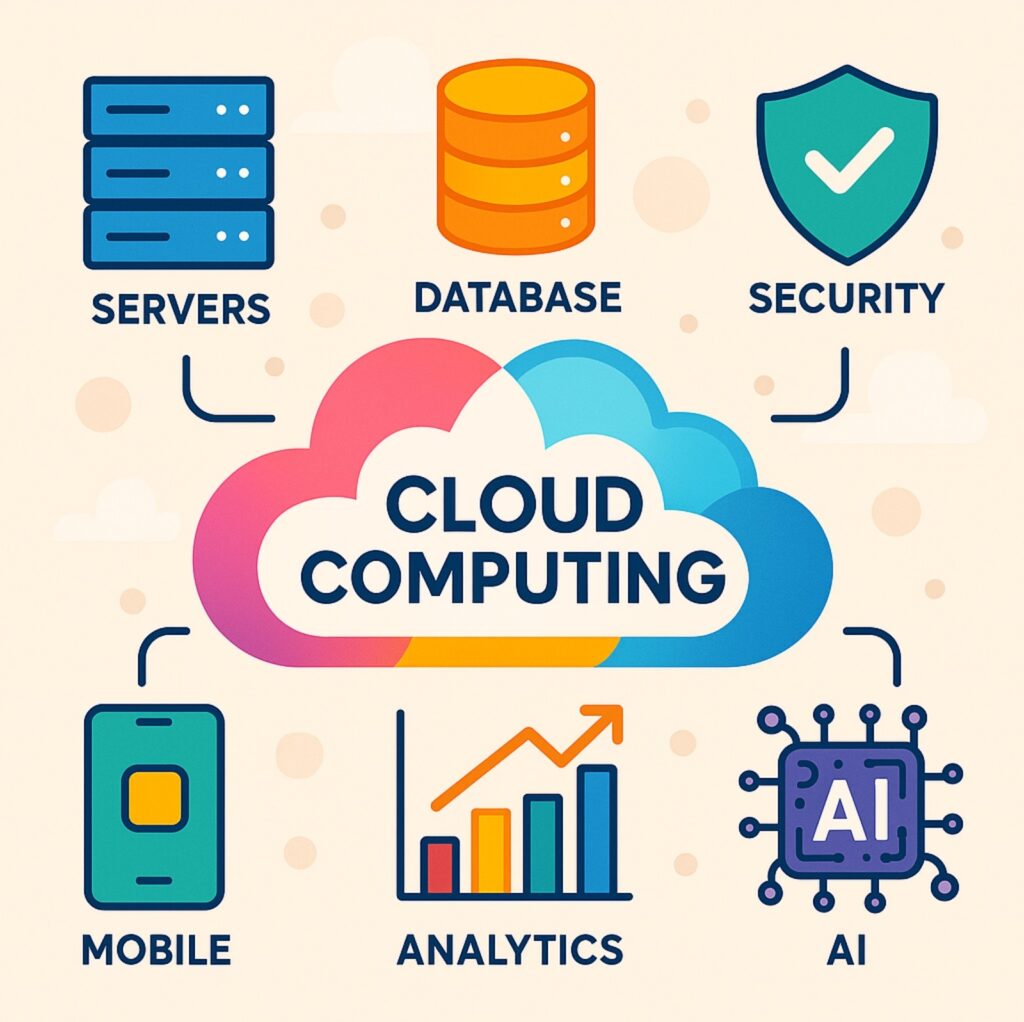
- AI-Native Cloud Services: Cloud platforms are embedding AI into everything—from infrastructure management to data analytics. Tools like AWS Bedrock and Azure AI Studio make artificial intelligence accessible to everyone.
- Edge Computing: Bringing the Cloud Closer to Home: Instead of sending all data to distant data centers, edge computing processes information closer to where it’s generated—like having mini-clouds in your neighborhood.
- Serverless Computing: Code Without the Complexity: Developers can now write code without worrying about servers at all. It’s like having a magic code-execution service that scales automatically.
- Sustainable Cloud Computing: Cloud providers are going green, helping companies track and reduce their carbon footprint while using cloud services.
- Zero Trust Security: The new motto is “never trust, always verify”—making cloud environments more secure than ever.
🎮 Making Cloud Learning Fun: Gamification and Interactive Approaches
Learning cloud computing doesn’t have to be a boring slog through technical documentation. Here’s how modern educators are making it engaging:
Cloud Adventures and Gamified Learning
Companies like AWS offer game-based learning experiences where you can explore cloud concepts through interactive adventures, complete with animations, comics, and treasure hunts.
Virtual Labs and Simulations
Modern cloud learning platforms provide hands-on virtual environments where you can experiment with real cloud services without the fear of breaking anything or incurring costs.
Storytelling and Analogies
The best cloud educators use stories, metaphors, and real-world analogies to make complex concepts relatable and memorable.
🔮 The Future is Cloudy (And That’s Good!)
As we look toward the future, cloud computing is becoming less about technology and more about enabling human potential. By 2025, over 95% of new digital workloads will be deployed on cloud-native platforms. The cloud isn’t just changing how we store data or run applications—it’s transforming how we work, learn, and innovate.
Whether you’re a student exploring career options, a professional looking to upskill, or simply someone curious about the technology that powers our digital world, understanding cloud computing is no longer optional—it’s essential.
🎪 What’s Coming Next in Our Cloud Adventure
This is just the beginning of our journey through Cloud City! In upcoming articles, we’ll dive deeper into:
- Cloud Security: Keeping your digital treasures safe
- Cloud Economics: Understanding the dollars and cents
- Cloud Careers: Turning cloud knowledge into career gold
- Hands-On Cloud Projects: Building your first cloud application
- Advanced Cloud Concepts: Multi-cloud strategies and beyond
Each article will maintain this same fun, engaging approach while gradually building your cloud expertise. We’ll use interactive examples, real-world case studies, and plenty of analogies that actually make sense.
🌟 Your Cloud Journey Starts Now
The cloud revolution isn’t slowing down—it’s accelerating. AI is making cloud services smarter, edge computing is bringing processing power closer to users, and new innovations emerge almost daily. But don’t let the pace intimidate you. Every cloud expert started exactly where you are now: curious, eager to learn, and ready for an adventure.
Remember, cloud computing is fundamentally about making technology more accessible, more powerful, and more human. It’s about removing barriers so you can focus on what matters most—whether that’s building the next great app, analyzing data to solve world problems, or simply having your photos sync magically across all your devices.
Ready for takeoff? Fasten your seatbelt and prepare for an exciting journey through the digital skies. Cloud City awaits, and we’re just getting started! ☁️✈️
Stay tuned for our next adventure: “Cloud Security Secrets: Protecting Your Digital Kingdom” where we’ll explore how to keep your data safe in the cloud using analogies involving digital fortresses, security ninjas, and encrypted treasure chests!